
Part One: A Story About Carrie Evans
Part Two: Not A Story About Carrie Evans
Part Three: Why Not A Pride Flag In Minot?
The Supreme Court case Shurtleff v. Boston would not exist but for Coney Island, New York. The Brooklyn borough’s original inhabitants — a Native American Tribe named the Lenape — referred to the peninsula as Narrioch, which roughly translates to ‘always in light.’ At the turn of the twentieth century, the home of the world’s first roller coaster more than lived up to the moniker. In that way, the ecumenical Christian Flag shares a lot in common with the Pride Flag in that they were both born of celebration.
And I contend that both, among others, are now set before the Supreme Court.

For the papal faithful, it may surprise that America’s Playground was also the birthplace of the Christian Flag. But at the center of its creation was a common creator, a teacher. The man tasked with teaching Sunday school the day the Christian Flag was created was Charles C. Overton. His expected speaker, mysteriously, did not show up. But like a dove, Overton winged it.
In the corner of the classroom, he spied an American Flag which inspired a lecture on what could make up a flag symbolizing the Christian faith. Ten years later, Overton would partner with missionary Ralph Diffendorfer to create the Christian Flag. It broadly represents Christianity and its many segmentations. Over one hundred years later, and after some rural consternation, the flight of this flag sits at the Supreme Court.
The Contention of Shurtleff v. Boston
When a flag flies on the flagpole at City Hall Plaza, Boston believes it has utilized a right to its own expression considered government speech. When Harold Shurtleff applied to fly the Christian Flag, Boston rejected the application due to its religious nature. In various legal arguments, Shurtleff has posited that Boston’s flagpole should be considered a public forum and that preventing the Christian Flag from flying was discriminatory when considering past practices and precedents. There are many locations in the city that are considered public forums such as the Plaza. These spaces are open to any and all events, such as Gay & Straight Pride among many others.
This is a vast oversimplification of the case, which maintains twenty-three amicus curiae briefs and multiple requests for additional participants at the oral arguments taking place on January 18th, 2022.
A Reasonable and Informed Observer Doesn’t Even Go Here!
After spending time documenting the flying of the Pride Flag in America, I anticipate learning more at oral arguments scheduled for January 18th. But before these arguments, I want to demonstrate a weakness in Harold Shurtleff and Camp Constitutions' case by way of comparison they already welcome.
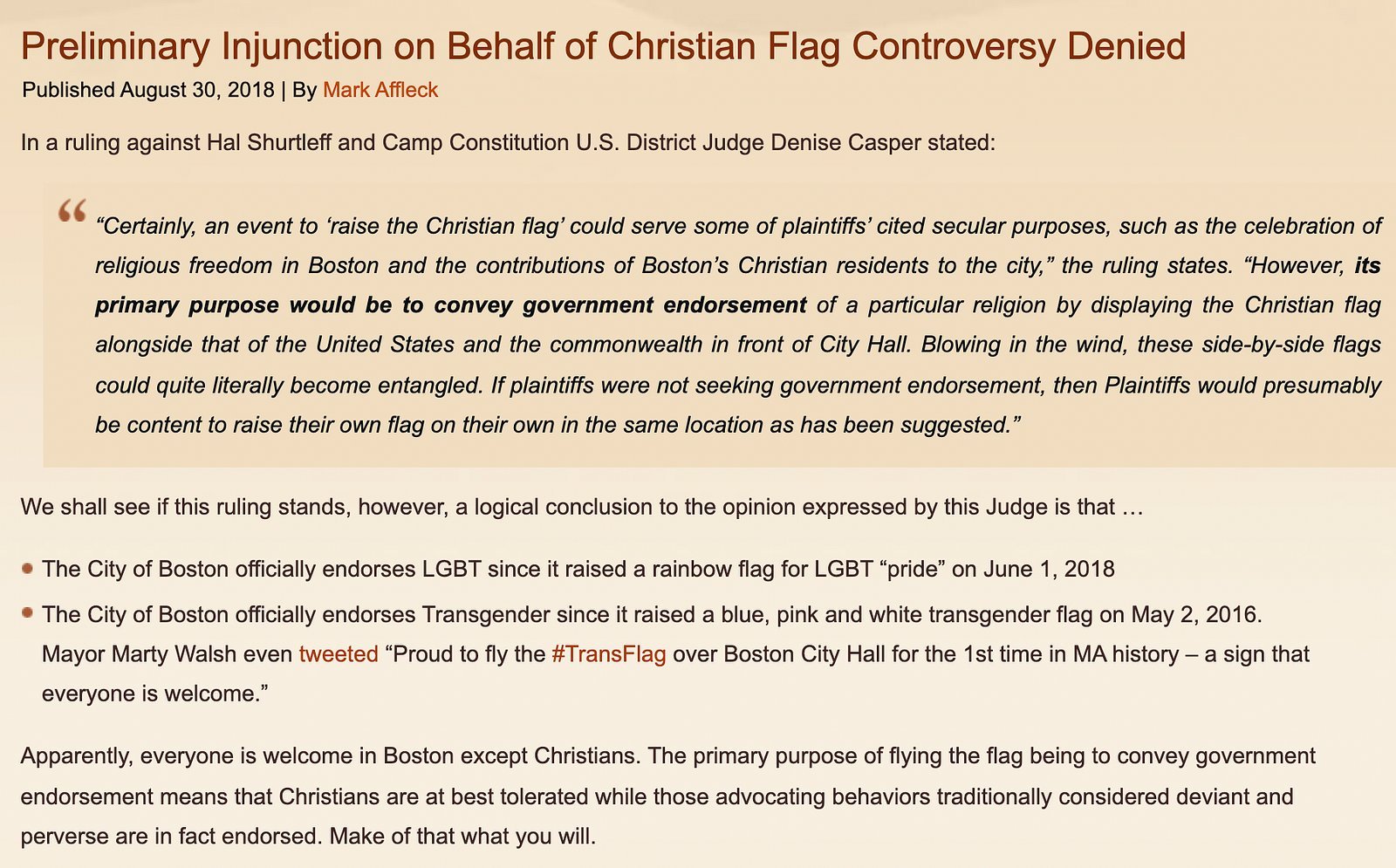
Comparing the Pride and Christian Flag is a false equivalency, though the use of the Pride Flag continues to be a discussion point across America. However, the linkage is one that affords the shredding of an argument being made before the Supreme Court. Shurtleff has suggested that when the City of Boston flies a non-government flag, a reasonable and informed observer would understand that it does not indicate government endorsement of religion or the adoption of private speech.
This argument can be disproven by the events I have documented in Minot, North Dakota.
In September 2020, the Mayor of Minot acted to fly the Pride Flag. Just as in Boston, no formal flag flying policy existed. At the following City Council meeting, thirteen individuals showed up to oppose The City of Minot’s flying a non-governmental flag. These individuals verbally attacked an elected official unrelated to, responsible for, nor capable of making the decision to fly a flag.

In doing so, these citizens have blamed the government for speaking.
It is not an isolated incident. At the following City Council meeting, a pastor — citing “two women in a sexual relationship” from his church, who had since left the congregation — showed up to oppose the city flying the Pride Flag which expressed to the community that the city supports a sinful lifestyle. He was soon followed by a minister from another church who repeated the logic.
These two Christians have to represent reasonable and informed observers in the eyes of Harold Shurtleff and his Christian summer camp. They associated a government flying the Pride Flag as speech demonstrating the support of ‘sin’.
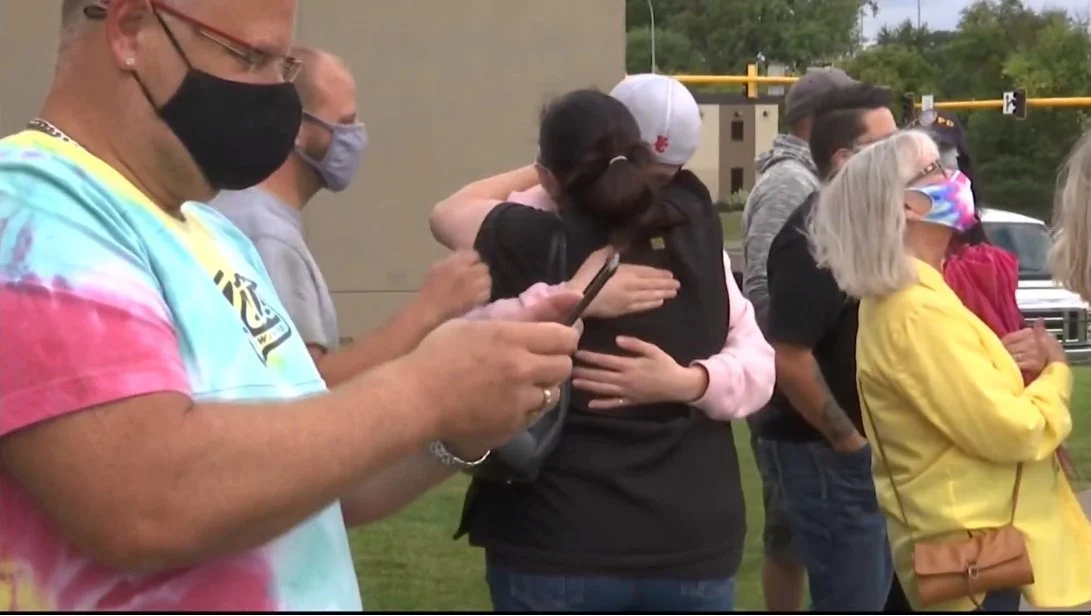
It is also helpful to understand what happened as a result of the City of Minot flying a Pride Flag. In addition to the death threat which prevented Magic City Equality from attending the meeting where Carrie Evans gave her viral speech, a Minotian mother received multiple threats of violence for appearing at the flag-raising on the local news.
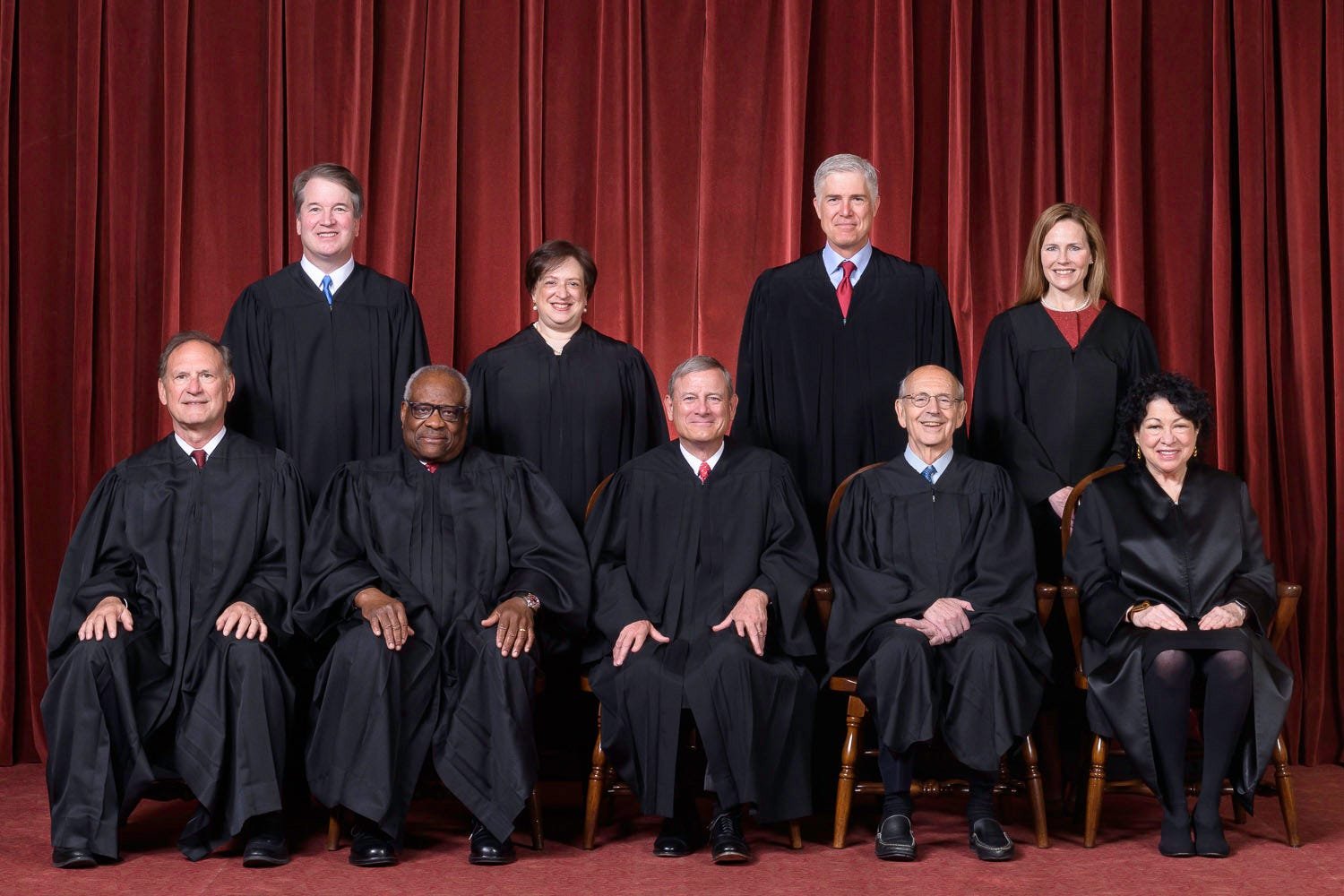
If the Supreme Court moves forward with the flag flying interpretations as proposed by Shurtleff and its aligned, though variously argued, amicus curiae briefs, the government will either declare their flag poles a public forum or stop flying non-governmental flags altogether.
What is the point of preventing this symbolic speech as preferred by an American government? What comes next when they are, in essence, forced to stop making these statements and who will that actually impact?
Thankfully, in America, an individual’s sexuality or gender expression is not, nor subject to, a religion. A reasonable and informed observer would expect the Supreme Court to recognize the difference.
Part One: A Story About Carrie Evans
Part Two: Not A Story About Carrie Evans
Part Three: Why Not A Pride Flag In Minot?
Donation Links:
Magic City Equality, the Evans4Minot Campaign, & Youthworks.
Originally published on Medium.