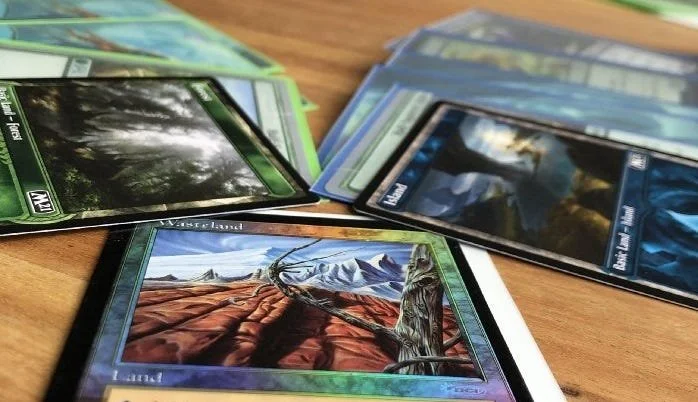
I believe Magic: The Gathering to be the best card game of our time. For younger and older generations seeking to understand the appeal of the now-aged game, I offer a brief primer, three lessons, and one goblin below.
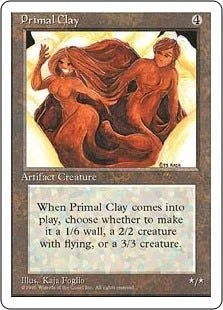
Released in 1993 by Richard Garfield and guided today by Mark Rosewater, one of my first memories of the game involved being entranced by the card Primal Clay, and not just for its looks. It had options! If I wanted to beat my next-door neighbor, I would have to choose one of three possible creatures.
Playing Magic: The Gathering is learning how to problem-solve independently. To do well is to need help; this is the best aspect of any social game. The intricacies and variations within are just as deep as the people who enjoy it as much as you will. What they can teach you about the game is chess, but in beautiful technicolor. The second best part? Magic: The Gathering is not just for grown-ups; you should never take anyone’s age for granted.
Even adults tend to forget how cute Magic: The Gathering was as a kid. Just look how USA Today described the game at eleven:
“Drop into any suburban American toy or hobby store on a Friday night and you are likely to find a bunch of intense-looking youngsters, as well as a sprinkling of adults, slapping down bizarre-looking cards and debating the relative advantages of the “creatures,” “artifacts,” “lands,” “spells” and “enchantments” in their hands. Those who are not playing are leafing through three-ring binders to find cards to trade in pursuit of a deck that will vanquish others.”
Intense-looking youngsters indeed!
During an era obsessed with some poor thing called the Beanie Baby, Magic: The Gathering became known as a collectible, which was also a game? At twenty-eight today, it is that aspect taking precedence and bold new steps into the future. The gorgeous online client, MTG: Arena was just incorporated into iOS & Android. With a slick onboarding process, the client requires game comprehension before new players are allowed open access to broader opportunities for play. They even give you some free gold! Wizards of the Coast — the company that develops and distributes the game — has also run professional competitions from the 1994 World Championship.
Not yet sold on this value-laden cardboard competition? In 2019, the MIT Technology Review published an article detailing how researchers Alex Churchill, Stella Biderman, and Austin Herrick determined Magic: The Gathering to be the “World’s Most Complex Game.”
I hope my experiences — and fictional flight of fancy in support of story-telling non-profit Playmaker’s Laboratories — will show you that there is no way to know what Magic: The Gathering will teach you, just that it will be worth it.
Unethical Acts Only Cover For a Lack of Strategy
A spot opens up for a caravan trip to Grand Prix Milwaukee, and I AM IN!
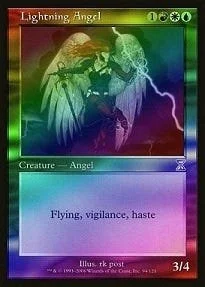
At seventeen, I want to try my hand at a professional tournament. But I am also rather naive and need guidance. I am talked down from playing land destruction by the owner of my local game store, Dark Knight Games. He convinces me to pursue an American Flag colored deck featuring my favorite card at the time: Lighting Angel.
I do admirably on the back of my diety’s wings, but her arch-nemesis shows why in the format she is only four-mana a Lightning Bolt. Despite this, her bolts conquer me to a four & two record, still in contention for day two. I find myself in need of two match wins to play the following day of the tournament. It also leads me to an incident that would lead the editor of strategy website Brainburst to declare:
“When I posted this article, I knew there was likely to be considerable dialogue regarding the issues raised, but it turns [out] I really had no idea what I was getting myself into.” — Scott Johns, Editor at Brainburst.com
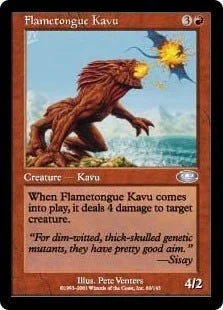
To win a tournament match in Magic the Gathering, you must beat your opponent in two-out-of-three games. After your first game of the match, you may amend the contents of your deck — also called a library — to address the game plan your opponent presents. It is this craft — called sideboarding — that makes tournaments dynamic, fun, and strategic.
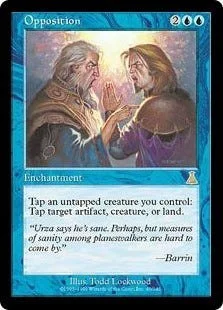
I lose my first game due to my opponent’s Opposition. At the time, decks built with this card in mind aim to play longer games that garner incremental advantages with various woodland critters.
It is in my hour of need — matches are fifty minutes — that I turn to religion.
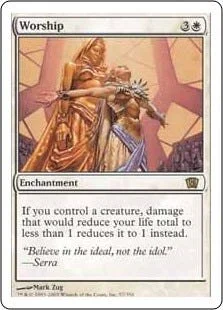
I add a few copies of Worship and look to my opening hand to see two enchantments: Worship and Goblin Trenches.
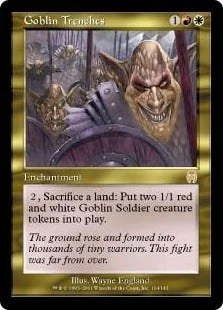
My plan of attack becomes clear. If I convince my goblin hordes to worship the lightning angel, they, we… I will win my next match.
& definitely the whole Grand Prix itself!
Denise of Freyja, the Foil Goblette
The flying thing’s hair matched a goblin’s skin. That was all the justification the malignity’s leader needed to follow Freyja. Set at the base of the Wreckage Mountains, the goblins had grown used to the range’s suspicious avalanches, but their chapel had proved sufficient protection as long as you were inside.
Kiki would, in his standard monotone, say that Freyja would melt all the snow soon. Denise couldn’t remember how many naps ago it had been, but the day she last heard him speak on it the day he fell through Freyja’s chapel floor. She remembered that the attendees were overcome with screams that willed the lax-eared goblette on from a front-row pew. Denise tripped trying to leap a pew on her way to aid the malignity’s rust-colored leader. When she got to the edge of the flooring, she saw that one of Kiki’s ears had gone out.
Kiki was still groaning when Denise lead the ten-goblin-chain down into the cavern. It seemed full-proof, the malignity climbed down caverns before, but they dropped her head-first at the first glint which struck their eyes. It was well before Denise’s head stopped throbbing that she noticed the cavern was not just a glint, but a full shine.
My opponent’s face drops as Freyja’s congregation grows. Most players of the time are aware of Worship. The enchantment— a distinct ‘type’ of card — prevents its controller from losing a game, in most instances, as long as they control a creature. I wait for an opportunity to cast my spell so as to avoid any counterspells and land the enchantment into play.
Our game winds on many turns as my opponent’s Opposition, their critters, and a sideboarded artifact — another distinct type of card — arrive. If I am to win, I will need to do so against a new roadblock named Static Orb.
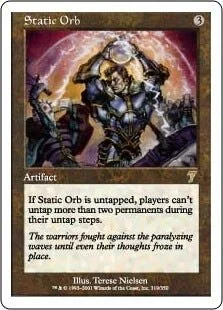
With my goblins stuck in their church, my opponent’s critters are unable to get in a final gnaw. We are in a stalemate, of sorts.
Magic: the Gathering has a fail-safe for this situation.
‘Decking’ is defined as a way to win the game when your opponent is unable to draw a card from their library. In stalemates, the first player to ask how many cards are in a deck will lead their opponent to do the same. Like many other areas of magic, it becomes simple math to determine what will happen for the remainder of the game.
I did the math, my opponent had fewer cards than me. I could win the game.
In the hopes of receiving a concession, I ask my opponent for confirmation of a way to destroy Freyja’s church. He assures me he can disrupt the harmonious anthems resounding out from her goblins with another famous card from the time; Upheaval.
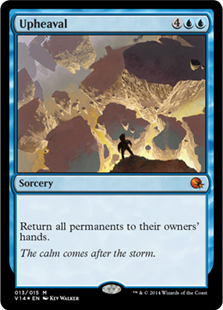
We play on for forty minutes.
My opponent maintains an intense focus on my play at each transition. Untap, upkeep, draw, main phase, attack phase, second main phase, and end step are a conversation, metered out, and bureaucratic. It is the type of discourse that fertilizes doubt in new players and I am under its siren song.
Was I making a mistake? Was there some card I was unaware of? Did my opponent just draw his Upheaval? Which card does he want me to untap? I begin to wonder why my opponent is so insistent on the phases of play during my turn, but casual upon his own. After the fact, a fellow Dark Knight player asked me why I hadn’t just passed on all my turns effects to speed up the pace of play. Because of the critter lockdown, I couldn’t do anything anyway. It would have significantly sped up play.
I finally call a judge and notice an uptick in my opponent’s pace of play. I had been asking why the game was taking so long, but it was not until double-digit turns. I lose the match with a games record of no wins, one loss, and a draw. My sitting in the tournament at four wins and three losses makes me incapable of making the second day.
With our judge grabbing at pens to finalize the match, I grab my opponent’s deck to pull it close. I discovered with a few flips that the Upheaval was not in his deck. His assertion was now exposed as a lie!
For anyone who knows me, it may not shock you that I decided to write an article on this indignity, which sadly no longer exists? I do still have access to the next day’s article detailing the controversy I had inspired. While I felt for the editor, I woke up that day in 2003 with over 100 rather pointy emails.

From what I could gather at the time, my opponent was well-known in Milwaukee. That day, he had been accused of cheating right before his win-and-in match. Considering he lost following my antics, having an article show up on a popular strategy website that accused him, again, of cheating… might have stung. He was right to be angry. All he did was be strategic, which is what makes Magic: The Gathering a special game.
The Ways You Can Win a Game of Magic The Gathering:
- Reduce your opponent’s life total to or beyond 0.
- Your opponent draws a card when they no longer have a library.
- Resolve a card effect that says you win the game.
- Convince your opponent to concede.
- Get a Judge involved who determines your opponent has cheated.
- [Online] Reduce your opponent’s clock to zero, as in chess.
The major component of any game is its ruleset, and each ruleset hides edges that competent players can bend to victory. As any game grows, so does its ruleset. It also suits to share that it is not a player’s job to play by the rules. That responsibility belongs to a judge.
With this in mind, the editor at Brainburst succinctly qualified the central issue at hand, saying, “When does lying become cheating, particularly if it was the reason you were essentially stalling in the first place?” But, it could also be understood as evidence of a lack of strategy. After the game, a fellow Dark Knight player asked me why I hadn’t just passed on my turns.
Because of the critter lockdown, I could not do anything anyway.
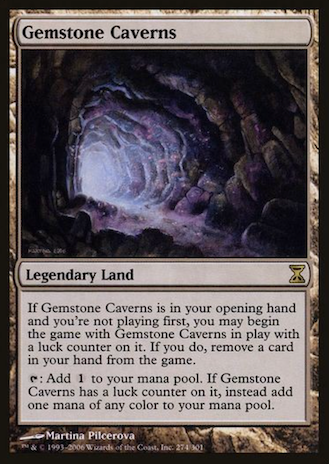
After the goblins determined Kiki was too damaged to be removed from the cavern, they sought a caretaker. It was Denise’s mother Richardselda who volunteered. The godmother was always committing to these requests, which left Denise at the bottom-most crevice for over 40 naps before Kiki finally recovered.
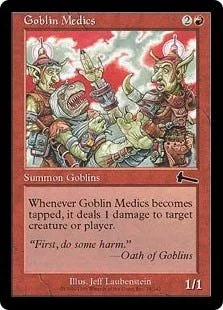
Denise felt the dread evaporate above her in Freyja’s castle when the news spread. She wanted to join in the revelry taking place, but Richardseld had told her to stay with the elder goblin.
Denise was spitting a sour grievance at her mother, but it only received a response from Kiki, “So you were the one who first discovered me after my fall?” His voice had turned frenetic and Denise cast a concerned glance up to Richardselda as she climbed the hastily arranged pew ladder. It wobbled as her careful assent all of a sudden stopped. Richardselda had heard it too.
“Matron,” cracked Kiki, “Things are now how they are, but the heralded change will come. Go spread the good news and remain warry of their affects, for which you are now unprepared.” Richardselda’s face made an expression Denise could not comprehend
K.J. asked as reflections from the party above refracted into their crystalized prison. Denise just bowed her head to her fists and then began to cry. “Oh, yes, I hear you have been kept with me for some time now. I imagine you are well sick of this magical place.”
Denise's only reaction was to watch her tears play a glaze and glisten between the cracks in the gems. The first three sections of seating had collapsed into the cavern over the last few weeks of worthless extraction attempts. Denise let out another cry, “I could have been outside this whole time if Richardselda had let me leave.”
Denise then heard a loud ping echo through the chamber and part of the cavern’s vertical entrance collapsed to shatter only a few feet away. She jumped to the side far too late to have avoided being hit, but at least it was further in from the flooring which hung precariously above.
As Denise sat down again, she spied K.J.’s fire-pearl ears. They were both lit.
“Yes, but you will have plenty of time to be outdoors. Squee will see to that.” K.J. said. Denise had never heard of what was probably just another gobmother. Denise had stopped learning names as it seemed even more Goblins were coming from the woods than before she began living in the cavern. Denise heard him sigh and looked up to see him stare at where the floor above them had crumbled, “I suppose they could have helped us out of here before they began to celebrate my supposed survival.”
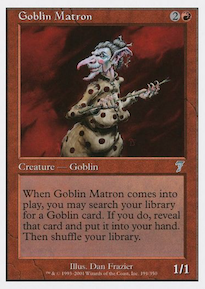
Denise’s gobmother Richardselda had welcomed the new arrivals to an ever-increasing portion of what had previously only been Denise’s bed, or at least that is what she was told. Ten naps later, the little goblin had finally escaped the cavern only to find out the tale was a lie. The new goblins had destroyed Denise's bed, spreading the stuffing out all over the floor for comfort.
It got even worse with the new restriction — another result of what was increasingly becoming clear was the result of the cavern’s discovery. The critters had been attacking some of the new goblins and K.J. determined that anyone under five-thousand naps would not be allowed outside during the daytime. That was when the sun basking creatures were out, hungry, and responsible for the disappearance of so many goblins.
Richardselda was particularly adamant about the rule, but Denise felt her mother would think differently had she seen Denise touch a critter.
It… seemed fine.
She touched it during the day even! She and Kamahl had rushed home only to be blocked by five large mongrels in a heap. The two were convinced the critters were dead, but as they tip-toed by, Denise and Kamahl both tripped over the hounds. Both goblins cried out, but the animals only proceeded to shift. One rolled completely over onto its back, leaving a belly exposed.
It was after that when Denise and Kamahl had first discussed escape, at least for one day of sun. It would redden their skin and they were both around three-thousand naps. That meant together they would be fine.
They would have Menges, Denise’s stuffed bear, too.
It only took the two of them around thirty naps-time to figure a way out. And once Denise punched out a ground-floor window, the two sprinted past all the advanced-rest goblins to enjoy a frivolous day in the woods.
And this was true until at a four-thousand goblins throw they met Maglan.
Research Dominates Skill
For the uninitiated, early Magic Online was an online card game.
But for the initiated, early Magic Online was the Wild-Wild-West.
I did not have a PC or the funds to buy my way into the novel internet program. However, what I lacked in computational and financial resources, I made up for in hustle. At the time my only opportunity to play was at my local game store, so I would live my early-aughts fantasy as a young man huddled over one computer with other men at Dark Knight Games.
The local game store is what you expect. A motley crew of white Minnesota eccentrics with a taste for cardboard, small figurines, and math. But after the release of Magic Online, we dive headfirst into the opportunity to play and trade online.
I realize that I am rather good at what I now remember as, well, theft. To calm the nerves of the real-life cardboard “not-a-stock-market” stock market, Wizards of the Coast has agreed to sell digital packs at their full retail price and offer physical cards in exchange for collecting an entire set. It is a strange setup, but also one of the first instances where monetary value is ascribed to digital objects traded between users online. What the Dark Knight Games crew contrives is not stealing, per se, but there are not many adroit traders among those newly interested in Magic Online. Trades involving basic lands for digital cards worth $10 or more become commonplace and the store’s ‘Cutstep’ account benefits as a result.
But we also teach each other to play the game. The group sits around discussing the best plays while multi-tasking our trading schemes. We conspire against whatever opponent we face and whatever sap is foolish enough to accept our trade requests.
But the real value is in what we teach each other about the game.
“What is the best play here? Attack?”
“That play? It just lost you the game. You know that, right?”
“Well, you’re playing Jon Finkle. What did you expect?”
[pickup]
Richardseld lingers in the door to Denise’s room at Mr. Maglan’s castle, “You have to come with us.” A sparkling glow surrounds Richardselda, almost making her appear deified. But it’s just the wall. All the walls at Mr. Maglan’s underground castle have a sense of glittering magic to them. They had impressed Denise until time had worn on to make them more commonplace. Now all she could focus on was the shoddy woodwork of the now larger contingent of goblins Mr. Maglan had surrounded himself with.
The decision to follow Mr. Maglan is a whirlwind of good fortune despite Denise’s initial reluctance. She was only just beginning to ponder the Vorzani Conjecture after the voracious appetite for the books became contagious when Mr. Maglan lost his balance behind Richardselda. He left his lean upon a rickety railing as he adds, “If you come to the Bidding, we’ll free your kin from the church. Don’t you think they’d like it in my castle?”
A moment passes as Denise takes a pause. She shakes her head, “What makes you think they’ll come?” The silence hangs amongst a shimmer as she returns to her shoddy copy on fractal theory, “They had their chance to leave. Don’t you take care of enough goblins already?” The two adults stare at each other because they both know the assertion is correct. After a few days in Mr. Maglan’s cavern, it became clear the clusters of planeswalker abandoned goblins housed here was not an accident.
“Denise,” Richardselda moans, “If it wasn’t for me, you would never have met Mr. Maglan. I know you have become comfortable. But you have met so many different goblins and learned so much from them. Even Menges looks made of stronger stitching.” Denise looked to glistening walls as Richardselda spoke the name of her beloved green-eyed bear. “Mr. Maglan wants to go get our friends from the church. Don’t you want them to have the same opportunities?”
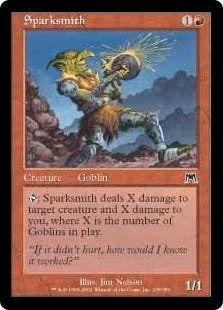
Her mother had a point. Denise had met such interesting goblins over the last few months. The sparksmith made her a forever flaming flower that lit her late-night studies, the prospector who taught her the ways of drawing mana from those around her, the war chief who would defend them in battle, and the sharpshooters who would ensure they won it. But Denise knew she was Mr. Maglan’s key to ending the critter’s siege.
The looseleaf book almost spills off her lap as Denise throws her ears into a ponytail and closes her eyes. If it would make Richardselda and Mr. Maglan happy, that might be worth the effort. She would just need to be present. Denise opened her eyes and sighed only to say, “Fine, but Menges is coming too.”
Back around 2003, great players are pushing Magic: The Gathering’s competitive evolution through the internet. Professionals at the time find solutions to formats by noticing trends prevalent within each format and crafting action from what they learn. New decks emerge that take advantage of established strategies and turn the tournament scene on its head.
As more examples of these decks crop up over time, players learn to keep an eye out for opportunities. With actual value assigned to digital cards, spotting a shift early can mean an exponential growth to the value of your collection. Over the years, players learn how to spot these opportunities faster and faster as websites begin codifying tournament results now and worrying about the implications after.
But in the early aughts, new decks would show up well after a new set’s release. Those who launched these unanswerable daggers into what had been stable formats would win major tournaments decisively. And others paying attention to the situation are rewarded as well.
It is a sunny weekend in July and I am where you would expect — ringing up the occasional sale at Dark Knight Games while trading and playing Magic Online. As the leader of the famed Clan Lame, I have gathered a few dedicated players and we chat about bad beats, great trades, and whatever else is happening in our lives. But on that day, a Clan Lame member messages me with some urgency.
“Have you seen the results at the Grand Prix?”
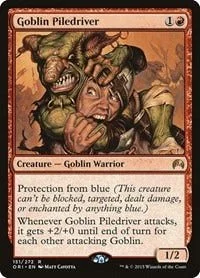
Denise had relented. She left her studies behind to travel with an ever-expanding party of Goblins. Some of them make her nervous. The sledder seems far too eager and almost breaks into a fight with the piledriver before backing down as the siege-gang commander tells him his bark is much worse than his bite. Everyone knows it to be true and the fight dissipates when Mr. Maglan finishes his chants. Denise's floppy ears stiffen, not sure what the point had been.
As the ruckus dissipates, the beasts are visible in the distance. Denise can see them rear up, howling and clicking within their thick forest. To her surprise, Denise’s powers have strengthened since she last saw the woodland animals. As Mr. Maglan’s group reaches within 500 paces, Denise watches as the smaller animals begin to yawn. If they fall asleep in their forestry ramparts, it will be an absolute slaughter.
A whisper sounds as a rootwalla falls from a tree, “You don’t have to do this.”
Denise looks around and grips Menges close but there is nothing of note. Only Mr. Maglan turns his head.
“Take five steps left,” the voice whispers again, “You have ten seconds.”
Mr. Maglan stops, his face crinkles, and looks behind Denise. It appears only the two of them can hear the provocation and his eyes are focused far off behind the group.
Denise pretends to hear nothing and continues walking forward while counting; ‘One, two, three.’ Mr. Maglan is more than fifty paces away, Denise knows he cannot reach her in time. But his magic is strong and she has seen him use it upon others from farther distances.
‘Four, five, six.’ Denise cringes at the coming slaughter. This is not her fight. Freyja’s malignity had their chance to leave months ago and Richardselda has only supposed they would want to leave now.
What would Mr. Maglan do to them if they wanted to remain?
‘Seven.’ Denise turns her head to see a fast encroaching black and blue mist as Mr. Maglan starts to chant, “Braids…”
‘Eight.’ Denise turns to her mother and gives her a hug, “I love you.” Richardselda looks confused but embraces her back.
“Braids…”
‘Nine.’ The diminutive goblette pushes away from her mother, “I have to go.”
“Braids!”
‘Ten.’ Denise dives the five paces as Mr. Maglan’s magic hurtles toward where she will land.
The mist reaches her first and Denise feels two solid arms grasp her and veers away. The magic misses by inches, leaving decrepit grass in the spot where she would have landed.
The smell of the mist frightens Denise until she hears the voice say, “You’re safe now.” Grabbing for more stability, Denise grabs at the mage’s side looks up to see a mage amongst the mist with a staff strapped to his back. He is pale with short black hair and Denise thinks that this must be another human. Mr. Maglan screams as the pair speed away, but all Denise can think about is what problem this human will serve her as a solution.
I race off to the Wizards of the Coast website covering tournament play. On my way there I am more than confused. I had not been aware of a tournament taking place that weekend. Back in the early aughts, most well-regarded Magic: The Gathering tournaments take place in America. I am elated to discover the event in question is Grand Prix Bangkok.
At the time, there is a not-unbelievable bias against non-American tournaments. The tournaments are not as competitive, the players who emerge from them are not as good, or the game just doesn’t translate as well are of a variety of suggested theories. But it is this bias that promises great things to our Cutstep account as I sit in downtown Mankato, Minnesota on that beautiful July weekend.
Grand Prix Bangkok is best known not just for Tsuyoshi Fujita’s interpretation of a deck created by Eder Wolfgang in Europe, but also for the two friends who joined him in playing it. The format is almost two months old at the time of the event, but Fujita’s version brings all three of it’s players to the Top 8 in a field of over 250 players. For a new deck to come out and destroy a major competition in such a convincing fashion was unheard of.
To top it off, in America, the news was literally unheard.
I suit up and pilot the deck myself over the next month and am inundated with requests. What was this deck? How did you find out about it? Is there a list somewhere? I share the information of course — even back then most decklists were only a Google search away. It still takes around a week before I see my first mirror-match — when two similar decks play each other. As a result, Dark Knight’s Cutstep account experiences an unreal win streak and we rank up to 8th in the world.
That deck was Goblin-Bidding.
The carnage which follows Denise’s departure is horrendous. She knows the boundaries of her power are no longer enough to protect the inhabitants of Mr. Maglan’s castle and the woodland critters pounce.
Mr. Maglan backs away from the throng as the goblins and forest critters saw away at each other. Despite losing Denise and her powers to the mist, the malignity’s leader begins a chant. Denise had seen the man cast spells, but they are concluded faster than whatever he was preparing now.
Mr. Maglan’s war party needs help. The goblins are far outnumbered near the edge of the woods. Denise lets out a cry as a few squirrels gang up on Richardselda. She takes a few on before succumbing to their chitters and nibbles. The mongrels tear apart the piledrivers, the sharpshooters, and even the sledders. A rootwalla grows to swallow a sparksmith whole only to explode a few seconds later.
“Don’t worry little one,” the man says, his mists enveloping her and obscuring her vision as they whiz away, “This is not Virot’s first dance.”
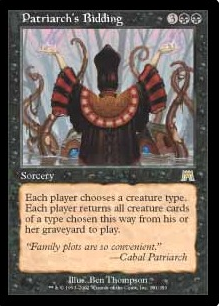
“Rise,” Mr. Maglan shouts, “Rise!”
A looming gloom begins as Maglan’s dying army stirs on the ground. Awkward movements bring broken bones straight, gasps express themselves, and Denise watches Richardselda stand with a new, but familiar-looking goblette with floppy ears.
Despite some newly nimble mongooses rejoining the fight, the tide of battle turns. The fight is won in the next minute when Mr. Maglan casts his spell one last time and Denise‘s ears go flat along her neck.
“See,” the mage says, turning them away, “He did not need you.”
Denise begins to relax into the mage’s grasp and he slows their drift. He moves her onto his back and Denise utilizes Menges to clasp her hands on the mage’s chest for support.
“Where are you taking me?” Denise asks, trembling a bit to hang on. The pain begins to leave her biceps as the mage leans forward and their drift speeds up.
“Virot’s efforts are nothing,” the mage spits, “You must stop the Psychatog.”
When Your Luck Runs Dry Is Entirely Relative
Regionals in Lincoln, Nebraska is the only other major in-person tournament I attend. Unlike Grand Prix Milwaukee, I am better prepared, though my mother’s jet-black Corolla would barely escape.
A Dark Knight Game’s crew departs Minnesota in the early morning with intentions on a Top 8 spot at the tournament. Doing so will garner a player with an invitation to Nationals taking place later that year.
The best part of the in-person Magic: The Gathering tournament experience is watching your friends play high-stakes games from five feet away. These matches provide ample conversation fodder throughout the day and you cheer for anyone in your group who does well.
How pumped were we for the tournament? After the five-hour drive, we see the strip mall with a long line of (mostly) men, (mostly) sat outside a set of doors leading into a gaming hall. Living the dream, our driver hits the gas and we speed thru the parking lot. Along the way, we hit a lip on the pavement at such speed that my mother’s Corolla catches full air and I feel weightlessness like a theme park’s slingshot. The car tips on its axis and we drop precipitously onto the pavement.
As we land, I hear loud scratching and our group’s eyes collectively widen in tandem. When the Corolla reaches a non-descript parking spot without any further incident, I am amazed we find no visible damage. Unperturbed, and unbothered to check anything deeper than superficial damage, we wait in line for the doors to open and our tournament to begin. The one truth that mattered to us that morning reigns supreme in our minds; anything less than the top 8 is a failure.
The mage had begun to explain himself and the new journey Denise found herself on. “It’s not a matter of if, but when you will meet the Psychatog.” Denise saw them approaching the mountain behind Freyja’s church. “They are capable of existing with others, but they choose to only consume them.”
Denise squinted from the wind but also some skepticism. “And what does that have to do with me?”
The mage sighed. “It is all rather simple when you know more about the abomination.” He pointed his staff above the mountaintop and they began to tilt upward to and fly above the plains. “If you were willing to be part and parcel to the slaughter of the wildlife surrounding your church, I figured you would also want a hand in destroying the creature who consumed your god.”
“Freyja was eaten by the Psychatog?”
“Yes, but that is not the only thing to be afraid of concerning its impending menace. The creature also digests the experiences of those it consumes for the purpose of finding more prey.” The mage spit again, “It is only a matter of time before it comes to her church, and thereby only a matter of time before it comes for you, your mother, and everyone else you know.”
Denise’s eyes widened and her ears crippled. If a Psychatog could eat a god, what would a small goblette be able to accomplish? She squeezed the mage and Menges tight, “But… how… what am I to do about it?”
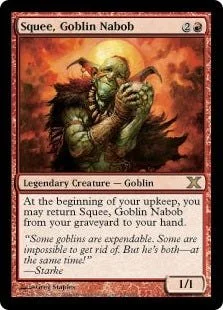
“You’ll need to defeat it. I can keep the Psycatog at bay, but only for a short while.” They began to level off and Denise saw a vast ocean on the other side of the mountain. “I don’t know how you’ll do it myself, but Squee said only you have the power to slay the Psychatog.” The man’s face grew quite serious as a green glow protruded in front of the pair from the blue-black mist.
Denise had felt some relief when this mysterious human saved her from Mr. Maglan’s Bidding. “But why me? I am tired of having to always go somewhere and do something. And who is Squee?”
They crossed the mountain top and Denise saw the Psycatog lain prone under a massive willow tree surrounded by blood. She could see that it had sensed their presence as even at this height she saw the creature’s eyes dance from slumber to a feast.
“He said you would meet him one day.” The mage exhaled, “Denise, you are welcome to be tired, but that feeling passes. What little goblins do not understand is that to not go somewhere or do something is to wait for another to come somewhere and do something to you and those you love.”
The green glow intensified as they descended upon clearing and the Psychatog gathered itself onto its feet. All the hair on her stood at attention and Denise’s floppy ears went erect. She held Menges close as she jumped off the mage’s back onto a bloody plain.
The man stared upon the ocean and the Psychatog took a leering first step toward where the two stood. Its saturated green skin shifted in an uncomfortable fashion as the clawed creature began to grow. The Psychatog bore its teeth and let out a low, hissy, “Miiiiiiiiiiiiiiiiine…..?” that flipped into a higher register.
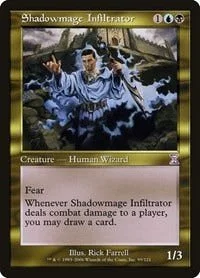
The mage spun his staff between both hands’ grip and found an offensive-looking float. He hovered about and approached with some caution. The blue-black mist that surrounded him began to expand. He let out a yell, “The shadowmage people will no longer be overshadowed by the likes of you!”
The format’s metagame — a selection decision ‘game’ for one tournament, think rock, paper, scissors — for my regionals event appears healthy as a few competitive options are available. While there are a variety of decks one can choose from, the prevailing consensus is that the previous ‘best deck’ of the format — referred to as Upheaval/Psychatog — has been losing its luster.
A popular construction of the time relies on pooling mana, casting Upheaval, and dropping a Psychatog onto the battlefield against your opponent. Deck’s featuring Pyschatog traditionally only had one or two chances to kill an opponent. If your Psychatog got removed when a lethal blow had been prepared, you may as well have left the table and the tournament at the same time. Beyond that, the deck consisted of counterspells, removal, and card drawing spells like Fact or Fiction.
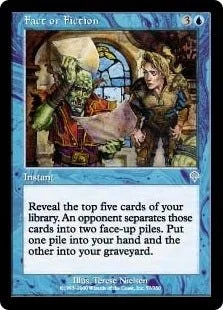
This all-or-nothing strategy is very difficult for inexperienced players. Many see their Psychatog come up short or smothered by players with a better understanding of the rules, math, and timing work for the deck. At some level, the popularity of a deck can attract weaker players. This leads some to believe that deck no longer occupies a format’s throne when it is instead the case that more players are just not capable of executing the strategy of the deck.
My playtesting suggested that while it may be true that the field has adjusted to counter a standard Upheaval/Psychatog game plan, a variation of the deck with more creatures like Shadowmage Infiltrator appears to perform well as opponents only pack enough creature removal to manage a play set of Psychatogs.
Fun Fact! Shawdowmage Infiltrator, a/k/a Finkle, is one of a handful of cards designed by the Magic: The Gathering’s World Champions — a tradition which started with Olle Råde in 1995, ended with Tiago Chan in 2007. The honor only has only one exception — Tsuyoshi Fujita of Goblin Bidding fame.
After seven rounds I am 7–0, sitting at the second table. An acquaintance who has already dropped from the tournament guffaws, “How are you sitting there?”
I have not eaten. My early day jitters, short flight, and all-around nervous energy have begun to peek in. During the eighth round, I am in a winning position for what feels like an eternity. Multiple turns pass and I draw land, after land, after land. My opponent looks on confused as I pass each turn. When he wins our decisive game three, he apologizes saying, “That’s some bad luck.”
I am devastated and the adrenaline I have built up over the day is gone. I am still in the tournament at this point, but to this day, my next memory is eating at a Denny’s after I have dropped from the tournament. My dreams for a Top 8 finish vanish that fast.
That is the nature of Magic: The Gathering.
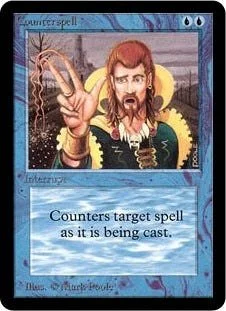
It is a game where, despite all your preparation, practice, and persistence, there is still a chance you will only draw lands. Sometimes your opponent has chosen a deck you are almost incapable of winning against, but even the best players in the game can only hope to reach a 70% win rate against other professional-level competition.
But at some level, the magic in Magic: The Gathering is that, despite its strategic nature which rewards logical decision making, the game remains one of chance. Just like the family you are born into.
My Denny’s consumed and my travel companions commiserated with, we begin our drive after a tournament well lost. It is late in the day already and we have a five-hour trip home. I remember little, knocked out after an exhausting day. As our luck would have it, the holder of our MapQuest directions also falls asleep just before a crucial turn and we end up traveling two hours in the wrong direction. Our driver decides to make up for lost time and we are pulled over near Sioux Falls for doing over 90 miles per hour in a construction zone.
I am woken up by a police officer tapping on the window of my mother’s Corolla. Our capture had already been assessed and things are not well. Jet-black cars, speeding excessively in the dead of night is already a form of folklore amongst many midwesterners, and here it has become my reality.
We all take sobriety tests and our driver spends time in the cruiser as the Corolla’s contents are strewn about the highway. The cop returns after half an hour dumbfounded that our story checks out.
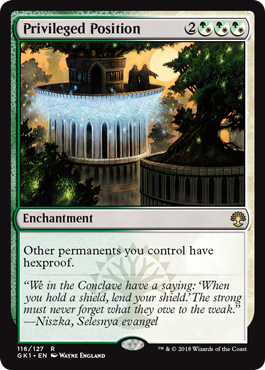
The law enforcement officer would let the Dark Knight Games’ crew off with a verbal warning. He suggests we stop off at a gas station, catch some sleep, and buy a coke. As fortunate as we are to escape the ticket, or worse, I still wonder what the result would have been where, everything else remaining the same, the color of my magic cards reflected in the color of my skin.
In retrospect, it may have been rather green to expect any different. We were tired, white, and I got to show the police officer my sweet blue-black deck.
Denise stared, stunned to the half-grass half-blood muck she had landed in following her dismount from the shadowmage.
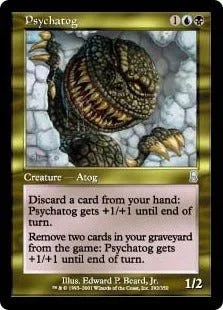
He had got one sharp attack into the Psychatog’s side before disappearing into its gaping jaw. Both were eager, but only one remained.
Denise wondered how someone capable of flying over mountains had been reduced to one boot on the ground with his leg still intact.
It was so sudden too — she had expected a bit more time. It must have only been 15 seconds after they had landed. Denise let out an audacious sob and began to hug Menges again.
The Psycatog belched up the other boot and it landed ten paces from where Denise had tucked into a squat, crushing Menges within her. It was only then that she began to notice the green effervescence had exuded from Menges, not the mage. The brown stuff made of fluff now had eyes of emeralds and its mouth grinned with them as well.
She raised her head to look in at the Psychatog.
The Psychatog cricketed, “Miiiiiiiiiiiiiiiiine…..?”
“How dare… you… eat that man,” Denise stammered.
The green flesh stretched as the Psychatog responded, “Miiiiiiiiiiiiiiiiine…..?” It was almost double the size from when it had consumed the mage.
“How dare you eat Freyja,” Denise stated.
The Psychatog licked its pointy teeth one by one and hissed.
Denise glared into the cavernous mouth, “How dare you presume to eat me.”
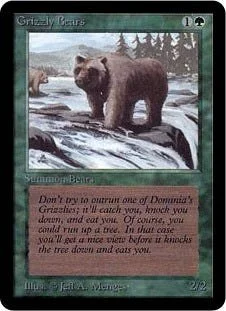
And then there were bears. Many bears. Mama bears, papa bears, baby bears, panda bears, polar bears, black bears, brown bears, sloth bears, pizzly bears, and bears clad only in leather. It was a pack of bears in the multitudes not even the critters around Freyja’s old church could have hoped to endure.
Denise heard Menges growl.
The Psycatog’s head bounded between the scene. As if it could capture them in just one glance. But all the Psychatog could muster was one audible gulp.
The last thing Denise remembered hearing was the sleuth’s aggressive, unfathomable, and contemptuous snarl.
That was the moment Denise and Menges vanished into the Blind Eternities.
—
Thanks for reading!
If you learned something valuable, please consider supporting Playmaker’s Laboratory. This non-profit pursues the following objectives for Chicago Public Schools students:
- to teach fundamental creative writing skills;
- to provide consistent and nurturing attention to each student over a sustained period of time;
- to build each student’s confidence in self-expression, self-esteem, and writing skills;
- to perform high quality, professional theater to the students we serve and the broader community; and
- to form lasting partnerships.
Originally published on Medium.